Sunday, December 24, 2017

$200 Million Navistar Order from US Xpress Signals Trucking Rebound 2018

$200 Million Navistar Order from US Xpress Signals Trucking Rebound


Following several difficult years, heavy-duty truck manufacturing in the U.S. is poised for a comeback, helped by improving economic conditions and the replacement of older models with more fuel-efficient and technologically advanced semi-tractors.
Freight demand is growing, and shipping rates are rising, providing fleets with the cash to replace aging trucks.
Large fleets are jumping into the market and will be among the most active buyers, industry analysts said.
This was evident Tuesday when US Xpress, a large Chattanooga, Tenn., trucking company, reached a multi-year deal worth more than $200 million to purchase 1,665 International LT semi-tractors from Navistar International Corp. The deal includes 1,400 sleeper trucks and 265 day cabs.
“We had a chance to test one of their 2018 trucks and the test was extremely surprising. Fuel mileage was the best of class,” said Max Fuller, executive chairman at US Xpress. “We got pretty excited about putting this order in place.”

The sale was a notable conquest for Navistar as US Xpress is a major buyer of Freightliner Cascadia semi-tractors. US Xpress has 7,400 trucks in its fleet.“The things we look at are the total cost of ownership and whether the truck has the proper support programs in place – dealers that have parts, good warranties, things that support the product after the sale – and International does a pretty good job in that area,” Fuller said.
“To see trucks going down the highway with the US Xpress trailers behind them is something that everybody at Navistar will be proud of,” said Michael Cancelliere, president of Navistar truck and parts.
An improved outlook for trucking encouraged the large order.
“We are extremely bullish about the industry,” Fuller said. “My rates are up over 10 cents per mile in 90 days, I’ve never seen that happen in my career that started in 1970. There’s more freight than we can handle.”
Fuller said the industry slump ended in June. Others also see a rebound.
“We could see the return of the large fleets to the marketplace in fall 2017 for equipment to be delivered in 2018, and we believe that trend is only likely to gain steam in 2019 and 2020,” Michael Baudendistel, an analyst at Stifel Financial Corp., wrote in a report to investors this week.
Manufacturers are forecast to win orders for about 140,000 Class 8 semi-tractors this year, according ACT Research. That’s up 64 percent from the 85,400 ordered in 2016 but still down from the 184,500 of 2015, the research firm said.
The large carriers are looking at several factors that will push big-rig purchases, Baudendistel said.
A federal mandate that starts Dec. 18 and forces all truckers to have electronic logging devices that digitally track their driving time to ensure they stay within legal limits is expected to reduce the ranks of independent drivers who don’t want to comply with the law. That could push business to larger fleets.
Additionally, freight volume is increasing, creating more demand. In a July industry report, the American Trucking Associations forecast freight volume will grow 2.8 percent this year and will then accelerate to 3.4 percent annually through 2023. Trucking will remain the dominant freight mode – moving 10.73 billion tons of freight in 2017, or about two-thirds of all goods.
And shipping rates are rising. The national average spot van, or trailer, rate was $1.97 per mile in September, almost 11 percent higher than in August and 22 percent above the same month a year earlier, according to DAT Solutions, an industry data provider. Rates for refrigerated and flatbed shipments also are rising.
“We expect higher demand for truckload capacity to continue at least through December, with the movement of holiday-related e-commerce freight and the onset of the federal electronic logging device mandate,” said Mark Montague, a DAT industry analyst. “Demand may recede in February, which is normally a slack period, but we expect rates to remain somewhat higher than in previous years.”
The market is already starting to turn up, Baudendistel said.
“We believe October-December Class 8 orders in North America will average more than 30,000 units per month, up 60 percent from the same (depressed) period last year and 30 percent above the 10-year average level,” he wrote.
The US Xpress deal is an important endorsement of Navistar, which is working to recover from problems with discontinued engines and a large inventory of used trucks. The company earned $37 million in the third quarter, a turnaround from a loss of $34 million in the same period last year.
“It would have been easy not to invest in new product, but we never did that,” Cancelliere. “We invested over a $1 billion throughout the product line and we are not done.”
Michael Cancelliere. (Photo: Navistar)
In June Navistar shuffled senior management, naming Cancelliere as president of its truck and parts business and designating his predecessor William Kozek to head the company’s emerging technology strategy.
Navistar introduced the International LT Series Class 8 semi-tractors in September as a replacement for the ProStar, which launched as a 2007 model. It offers a series of improvements over the previous truck, including better fuel economy and standard advanced safety features such as adaptive cruise control and collision alert with automatic braking to reduce rear-end crashes. The US Xpress trucks will be powered by Cummins X15 engines, with deliveries starting in 2018 through 2020.
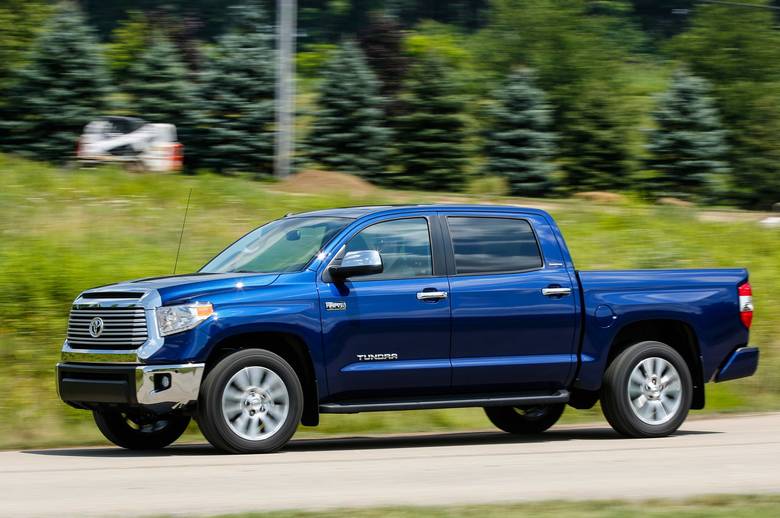
2017 Toyota Tundra 4x4 CrewMax Limited Technology 5.7

The Tundra was launched in 2000 and has cemented Toyota's position as the largest non-domestic player in the North American pickup truck market, along with the more compact Tacoma. Customers purchased more than 5,300 Tundras so far this year. It delivers 381 horsepower and 401 lb-ft of torque via a 5.7-litre V8 i-FORCE engine with a towing capacity of up to 10,400 pounds depending on the trim. Standard features on the Limited trim include dual-zone climate control, heated and ventilated front seats, a nine-speaker audio system, a seven-inch touchscreen infotainment display, integrated SiriusXM radio, premium navigation and a backup camera. 
  • MSRP: $55,605
  • Manufacturer cash incentive: $3,000 (applied after tax)
  • Estimated dealer discount: $1,500
  • Freight, PDI, government fees: $1,925
  • Cash purchase price before tax: $53,375
  • Finance for 60 months at 0.99 per cent interest for $1,082 per month and assumes zero down payment.
  • Lease for 48 months at 0.99 per cent interest for $768 per month including tax and assumes a 20,000 annual kilometre allowance and zero down payment.

2017 Chevrolet Silverado 1LZ 4WD Crew Cab Short box

Sales of the Silverado and its cousin, the GMC Sierra, collectively exceeded 69,000 so far this year, becoming the second-best-selling line of trucks in the country. The Silverado 1LZ is powered by a 5.3-litre EcoTec V-8 engine that produces 355 horsepower and 383 lb-ft of torque and is capable of towing up to 9,800 pounds. Its exterior features a chrome grille surround, bumpers, door handles and bodyside mouldings. Interior highlights include the six-speaker MyLink audio system with an eight-inch colour touch screen, SiriusXM satellite radio and the option to upgrade to a Bose sound system. The Silverado also has safety features that include forward collision alert and a rear vision camera. 
  • MSRP: $54,925
  • Manufacturer cash incentive: $7,100
  • Estimated dealer discount: $3,000
  • Freight, PDI, government fees: $2,389
  • Cash purchase price before tax: $47,214
  • Finance for 84 months at zero per cent interest for $642 per month which includes a $6,600 manufacturer incentive and assumes zero down payment.
  • Lease for 48 months at 1.5 per cent interest for $652 per month including tax, which includes a $4,450 manufacturer incentive and assumes a 20,000 annual kilometre allowance and zero down payment.

2017 Nissan Titan SL 4x4 SWB Crew Cab

Nissan sold 1,271 Titans in July, up more than 770 per cent over the same period last year, making it Canada's best-selling non-domestic pickup model that month. The Nissan Titan was redesigned for the 2017 model year and is equipped with a 5.6-litre V-8 engine that delivers 390 horsepower, 394 lb-ft of torque and 9,220 pounds of towing capacity. Standard features on the SL trim include two-tone painted 20-inch aluminum wheels, LED headlights, daytime running lights and tailgate area lighting, a seven-inch touchscreen infotainment system paired with a 12-speaker Rockford Fosgate-powered audio system and SiriusXM satellite radio, remote engine start with intelligent climate control as well as rearview and around-view monitors that offer a 360-degree view of the vehicle. 
  • MSRP: $62,550
  • Manufacturer cash incentive: $16,119
  • Estimated dealer discount: $1,500
  • Freight, PDI, government fees: $1,935
  • Cash purchase price before tax: $46,866
  • Finance for 60 months at zero per cent interest for $1,090 per month which includes a $5,094 manufacturer incentive and assumes zero down payment.
  • Lease for 48 months at zero per cent interest for $803 per month including tax, which includes a $5,094 manufacturer incentive and assumes a 20,000 annual kilometre allowance and zero down payment.

The best deals on pickup trucks 2018

The best deals on pickup trucks

The segment continues on pace for record-setting Canadian sales in 2018

More than 92,000 Ford F-series trucks have been sold so far this year, up 8 per cent over the same period last year. The F-150 Lariat trim is equipped with a 2.7-litre EcoBoost engine that generates 325 horsepower, 375 lb-ft of torque and a towing capacity of 11,800 pounds mated to an electronic six-speed automatic transmission with tow/haul and sport modes. Superior handling is achieved with Ford's AdvanceTrac technology with Roll Stability Control, which uses gyroscopic sensors to instantaneously gauge vehicle roll and turning rates to modify engine power and apply individual wheel braking to maximize traction. Interior features include dual-zone climate control and the SYNC 3 touchscreen infotainment system that connects wirelessly to Apple and Android devices. 
  • MSRP: $56,599
  • Ford employee price adjustment: $6,819
  • Delivery allowance: $4,750
  • Freight, PDI, government fees: $1,840
  • Cash purchase price before tax: $46,870
  • Finance for 60 months at 1.99 per cent interest for $928 per month (includes a $6,819 employee price adjustment and $4,750 delivery allowance) and assumes zero down payment.
  • Lease for 48 months at 3.49 per cent interest for $669 per month including tax (includes a $6,819 employee price adjustment and $4,750 delivery allowance) and assumes a 20,000 annual kilometre allowance and zero down payment

HOW TO FINDING a Great Car Deal

While you're selecting the perfect ride, you should also start researching manufacturer incentives that can save you serious money. When automakers need to boost the sales of slow-selling models, they use a number of methods. Financing deals, cash back offers, and subsidized lease incentives are the most common.
A financing deal can save you money by charging you a lower interest rate than you'll find on the open market. The current average rate for a five-year loan is 4.29 percent, so you’ll want to look for an offer that charges you less than that. The best subsidized interest rate offers are zero percent deals.
Cash back offers are a bit of a misnomer, as you’ll rarely get a pile of cash back. Rather, the offer will lower the price you pay for the car. For example, if you see an offer for $2,500 cash back, you can plan to knock $2,500 off the price of the vehicle. These deals are called by a number of names, including rebates, cash back incentives, and bonus cash.
For slow-selling cars and models that have replacements on the way, you’ll often find combination deals that include both low interest rates and cash back.
If you are interested in leasing, take advantage of the subsidized lease incentives offered by carmakers. You’ll find them on our lease deals page.
This December’s Best Deals
This December’s deals include a broad mix of offers on lingering 2017 models and early 2018s coming on the market. There are an increasing number of good deals on SUVs and crossovers, while some of the best offers are found in the compact and midsize car markets. If a car is mostly unchanged between 2017 and 2018, there's little downside to buying the older model – and you'll likely save a ton of money.
For example, the 2018 GMC Acadia sees few changes. You can get as much as $5,000 cash back on the 2017 Acadia, in addition to financing deals with lower interest than the current market rate.
With a redesigned 2018 Ford Mustang set to arrive at dealerships, now is the time to get Ford’s six-year zero percent deal on the 2017 Mustang, plus $1,000 cash back. This offer includes the Mustang GT, which has rarely been discounted over the last couple of years.
A big surprise in this month’s deals is the $5,000 cash back you can get on the all-new 2018 Lexus LC in the Northeast. In other parts of the country, buyers can receive 1.9 percent financing on this luxury sports car. It would make an excellent sled to carry your gifts to grandma's house, and it would look great with a bow on top.
To take advantage of the best new car deals, you will need a top-notch credit score. Before you start shopping, it's a good idea to check your credit report. That way, you can correct any errors and improve any weaknesses that are affecting your credit score. Improving your score by just a few points can get you a better deal on new car financing.
Car deals tend to come with a lot of fine print. Read all of the terms and conditions so you don't miss a critical piece of information that can cost you thousands in savings.
What Is a Good Car Deal?
The best way to buy a car is to focus on the total cost of the purchase, including the interest paid over the life of the loan. That takes a bit of work on your part; it’s best not to depend on a car sales associate, who will likely mix the price of the car, the financing, and the value of your trade-in together to produce a monthly payment. This is an easy – and costly – trap to fall into, and it’s not the right way to buy a new car.
A better way is to negotiate the price of the car before you start talking about your financing or trade-in. Having a pre-approved financing offer from a bank or credit union helps to take the games out of the negotiation.
When you have the choice of a financing or cash back offer, do the math to find out which will save you the most money. Always do this math yourself to ensure you understand the numbers and won’t get pushed into a deal that is better for the seller than it is for you. Buyers who will be making a large down payment, are paying in cash, or have a high-value trade-in will almost always want to opt for a substantial cash rebate. Everyone else should do the math.
Let’s use the 2018 Kia Optima SX’s deals as an example. Buyers have a choice of taking $3,000 cash back or getting zero percent financing for five years plus $1,500 cash back. We’ll assume you have negotiated a price of $30,500 and that you don’t have a down payment, meaning the entire amount will be financed.
With the zero percent financing plus cash back offer, you’ll take the $1,500 rebate off the top. That means you’ll finance $29,000 at zero percent. Dividing $29,000 by 60 months results in equal monthly payments of about $483.
If you opt for the cash back deal, you will have to pay market-rate interest on the balance of the cost. Since the math is more complicated, you'll need to use a loan payment calculator to figure out the monthly payments. First, subtract the $3,000 rebate from the $30,500 price. Next, finance the remaining $27,500. With six-year interest rates currently averaging 4.29 percent, the monthly payments come out to $510.
If you choose the cash back deal, you’ll end up paying about $27 more per month, or $1,620 more over the life of the loan.
Of course, you don't always want to opt for the lowest monthly payment. If you have to add a year or two to the loan to get a monthly payment that’s a few dollars less, it's probably not a good deal in the long run. You don't want to be paying for a car after its warranty ends, then find yourself adding repair costs to those monthly fees.
Before you sign on the bottom line, be sure to read the documents thoroughly to ensure that they reflect the deal you agreed to. Pay particular attention to the sales price, interest rate, and length of the loan. Beware of costly add-ons that can add thousands to the price of your new vehicle.
When car shopping, be sure to cast a wide net with your search. You might be able to save some money by purchasing your new ride in a location where the model is less popular. For example, think of buying a hybrid from a rural dealer or a truck in an urban area.
We research deals based on representative ZIP codes across the country. We strive to keep this list up to date, but deals can change without warning. Some offers are limited to a certain number of cars or a percentage of dealer stock, and inclusion on our site does not guarantee that a particular deal will be available at your local outlet. The easiest way to find out if you can take advantage of an offer is to click the orange button next to the car that you're interested in, and we’ll search for a great price at a local new car dealer.
Our best car deals include purchase deals for Toyota, NissanFordHondaChevroletHyundai, Kia, DodgeRamJeepMazdaBuick, GMC, Subaru, Volkswagen, Acura, Cadillac, Porsche, Mercedes-Benz, AudiBMW, and Lexus vehicles. Our expert researchers and journalists also search the market for this month’s best lease deals and best used car deals. We’ve done the research to help you find a great ride at a great price.

Top 10 Trucks of 2017 - 2018 Part 3


Top 10 Trucks of 2017

3) (Tie) 2017 Ford F-150

$26,730 | U.S. News Score: 8.8/10
The Ford F-150 lineup ranges from the rugged XL to the luxurious Platinum and Limited Trims. What also makes the F-150 unique is its selection of EcoBoost twin-turbocharged V6 engines. Ford’s SYNC infotainment system is easy to use and supports Apple CarPlay and Android Auto.
Ford also offers the Ford F-150 Raptor; a desert-going super truck for the trail. It has specially designed Fox Racing shocks, and under its hood is an EcoBoost V6 with 450 horsepower on tap.

3) (Tie) 2017 GMC Canyon

$20,885 | U.S. News Score: 8.8/10
The Canyon is technically a compact or midsize pickup truck, but you’d never know it from its imposing front end. It announces the arrival of a truck with a seriously upscale interior. The Canyon is available with the easy-to-use Intellilink infotainment system and the luxurious Denali trim.
If you are over chrome, GMC offers the Canyon with the more rugged All-Terrain X off-road setup. It has more dark plastic and isn’t afraid to get dirty. The cabin layout of all trims is like its big-brother Sierra 1500, so the controls are very logical.

2) 2017 Chevrolet Colorado

$20,055 | U.S. News Score: 8.9/10
Unlike the Canyon, the Colorado doesn’t try to be a scaled-down version of its big brother; it has a personality all its own. The Colorado is available with a frugal-yet-powerful diesel engine. For these reasons and others, it’s U.S. News & World Report’s 2017 Best Compact Truck for the Money.
Chevy’s answer to the Ford Raptor is the Colorado ZR2. While not as powerful as the Raptor, it features heavily reworked body panels for outstanding off-road approach angles. It also features advanced multi-matic shocks, front and rear locking differentials, and aggressive off-road tires.

1) 2017 Honda Ridgeline

$29,475 | U.S. News Score: 9.1/10
In this list, the Ridgeline stands alone. It became our highest-rated truck by doing things differently than traditional pickups. Though it looks more like a Honda Pilot with a bed cut into it, that bed has some terrific cargo innovations, like a trunk in the floor and a dual-mode tailgate that open vertically or horizontally.
The Ridgeline lacks a true 4x4 setup or the towing capacity of rivals. But it has a supremely comfortable, quiet cabin with high-quality materials. For many weekend warriors, this is all the truck they really need.

    Top 10 Trucks of 2017 - 2018 In USA

    Here Are the Best 2017 Pickup Trucks According to U.S. News Scores

    Once purely work vehicles, pickup trucks are asked to do more than ever before. In addition to worksite workhorses, they play the role of family vehicle, grocery getter, and weekend warrior. All the while, performance capabilities among the top trucks have escalated almost annually.
    If you are in the market for a truck, these factors can make picking the right one overwhelming. These trucks have fully modern safety features, the latest infotainment systems, and creature comforts that would make a luxury sedan blush.
    We’ve stacked up the top ten trucks based on the latest U.S. News & World Report overall scores for 2017 models. Depending on how you plan on using them, some trucks will be better than others. Read on to learn which truck is right for you.
    • 10) 2017 Nissan Frontier

      $18,390 | U.S. News Score: 7.8/10
      It’s been more than a few years since the compact Frontier has been updated, and that age shows in the cabin styling. The infotainment system is dated and the rear seat is quite cramped. Additionally, the ride on pavement is pretty rough.
      Another place where the Frontier has shown its age is its powertrain. Engines have become more efficient since the last time the Frontier was refreshed; even its highway fuel economy of 23 mpg is bested by several full-size trucks.

         9) 2017 Toyota Tacoma

    $24,120 | U.S. News Score: 8.3/10
    Like the Frontier, the Tacoma’s platform has become long in the tooth, but at least Toyota saw fit to update this compact truck in recent years. It can’t avoid certain common pickup issues, like a cramped back seat, but dashboard controls are easy to use and it has a newer infotainment system.
    The Tacoma also has 3,500 pounds of towing capacity, which is more than some of its rivals. But the real strong suit of the Tacoma is its off-road ability – especially with the TRD and immensely capable TRD Pro trims.

    8) 2017 Nissan Titan

    $29,580 | U.S. News Score: 8.4/10
    The Titan received a long-overdue redesign for 2017. The new Titan features a smooth ride, spacious seats, and an interior that can be optioned to be quite upscale. The Titan also has a very versatile bed that includes sliding tie downs, lighting, and power outlets.
    The standard Titan offers less towing capacity than other full-size trucks. You’ll have to opt for the heavier-duty Titan XD and its diesel engine to get close, and towing will still be bested by the Chevrolet Silverado 1500 and GMC Sierra 1500.

    Saturday, May 13, 2017

    Engine Review: 2017 Volkswagen Passat Highline V6 BEST CAR

    This is a review of the 2017 Volkswagen Passat V6. 

    That's right: it's not a diesel (obviously), not an artificially aspirated inline-four, not a hybrid. This sixth-generation Passat, delivered to GCBC Towers by Volkswagen Canada, is equipped with a six-cylinder powerplant breathing on its own: no turbos, no superchargers, no battery-electric whizbang. 

    A vee-shaped six. Six cylinders, arranged in the shape of a V, or as close as Volkswagen wants the six cylinders to resemble a V in its narrow-angle VR6 tradition. 

    3.6 liters of displacement in a 2.0-liter world. 


    THE GOOD
    + Mega motor

    + Massive rear seat
    + Quick shifting DSG
    + Big car mannerisms
    + Outside the box
    THE BAD
    – High price of entry
    – Anonymous design
    – Some fiddly controls
    – Big car mannerisms
    – Bizarrely dim-witted steering
    The V6 engine is certainly no longer normal, not in a class of midsize cars where the overwhelming majority of buyers choose a four-cylinder model and roughly half of all competitors don't even offer a V6 as an upgrade.

    Economics, regulations, marketplace trends, and technological advancement have conspired against six largeish cylinders. A torquey turbo inline-four like the 2017 Volkswagen Passat's own 1.8T will cost less, pollute less, satisfy the demands of most buyers, and surprise many with its real-world grunt. 

    And yet the six-cylinder lives, not only here in the 2017 Volkswagen Passat Highline, but also in the Toyota Camry, Honda Accord, Nissan Altima, Subaru Legacy, discontinued Chrysler 200, and in a new turbocharged Sport version of the Ford Fusion.

    Those nameplates accounted for seven out of every ten midsize car sales in Canada last year. 


    But we know only a fraction of those sales were produced by cars with V6 powerplants. For good reason.


    We've reviewed the Volkswagen Passat before. That diesel-powered car is no longer available, and some members of the competition have moved the midsize game on. Indeed, the Passat has been refreshed since then, as well. Nevertheless, unlike a typically thorough GCBC Driven review, this review focuses on the V6 engine option, rather than discussing the Passat as a whole. 

    You can, however, summarize the car this way. Bland styling masks a composed chassis that exhibits some of the tendencies of a hefty, traditional, American full-sized car: dead steering on the straightahead that's slow to react, just a hint of float when you want the car to button down during a mid-corner rise, too much body roll to properly battle the athleticism of the Mazda 6 or Honda Accord Sport. Torque steer, fortunately, is largely curtailed – 280 horsepower makes its way to the pavement fairly easily. The back seat is huge. The non-CarPlay tech interface is old but straightforward. From the typically comfortable Germanic seat, thick bolsters and firm cushions, visibility is excellent. Some of the newer safety tech added to this older design causes the Passat to feel older – they're not easily altered through strange instrument cluster sub-menus. 

    Review: 2017 Hyundai Ioniq Limited

    If you wanted to drive green, greener than Kermit, greener than Ireland, but you didn't want to suffer range anxiety or even plug in, there was nothing greener than the Toyota Prius. 

    THE GOOD
    + It's normal

    + Ultra-efficient city commute
    + Straightforward interior
    + Largely inoffensive manners
    + Big cargo area
    THE BAD
    – DCT not tuned perfectly
    – Rear visibility
    – Snug rear seat
    – Choppy ride, soft responses?
    – Niro? Elantra?
    Was being the operative word.The 2017 Hyundai Ioniq Hybrid is now the most fuel efficient gas-powered car on sale in North America now. 

    The Prius's reign has ended.

    Or has it? The Hyundai Ioniq may be more efficient than the Prius – it wasn't while in our care. The Ioniq may be better than the Prius overall, as well, though that depends on your priorities.

    But the Prius's reign in the marketplace may not be interrupted by a Korean upstart. Remember the Honda Insight? Honda tried and failed. The Insight is dead. 

    Prius is as synonymous with hybrid as band-aids are with, well, band-aids; as googling is with Google. 

    Does the Hyundai Ioniq have what it takes to be a successful interloper? Or will this all-new Hyundai be consigned to the Honda Insight's fate, which was killed off by the Prius after a brief five-year run?

    WHAT IS IT?
    Based on a new platform shared with the Kia Niro, the 2017 Hyundai Ioniq Hybrid is one of three Ioniqs. There'll also be a plug-in hybrid and a pure electric version. 

    Designed to tackle the all-conquering Toyota Prius in the dedicated green car field, the Ioniq Hybrid is presently the most efficient gas-powered vehicle in North America. Sized like Hyundai's compact Elantra, the Ioniq will be priced more like the midsize Hyundai Sonata. 

    The 2017 Hyundai Ioniq Hybrid delivered to GCBC Towers by Hyundai Canada is a top-trim model, the Limited with the Tech package, likely priced between $33,000-$35,000. The basic Ioniq Hybrid is the Blue model, likely priced just below $25,000. 

    There's also an SE trim, but regardless of the Ioniq Hybrid variant, the powertrain remains the same: a 1.6L Atkinson-cycle four-cylinder/1.56 kWh lithium-ion battery with 139 total horsepower hooked up to a six-speed dual-clutch automatic sending power to the front wheels. 

    HOW BIG IS IT?
    Compared with its most obvious rival, the Toyota Prius, Hyundai's Ioniq is slightly shorter bumper-to-bumper but also slightly wider and lower. 

    Besides getting more of the detailed styling elements right, the width and height help the Ioniq appear much less silly than the current Prius. 

    Hyundai says the Ioniq offers 2724 litres of total passenger volume, 3% more than the Prius, as well as 750 litres of very usable cargo space, 8% more than the Prius. 

    Compared with the Hyundai Elantra, traditionally Canada's second-best-selling car, the Ioniq is roughly four inches shorter stem to stern, an inch wider, and essentially the same height. 

    Passenger volume is virtually identical, although there's more headroom in the Elantra and three passengers will invariably find the Elantra more comfortable. Cargo space is less comparable, as the Ioniq is a hatchback. Compared with the upcoming Elantra GT, likewise a hatchback, the Ioniq should have 6% more cargo volume. 

    DOES IT WORK?
    In three major ways, the 2017 Hyundai Ioniq works better than the 2017 Toyota Prius.

    First, the shifter mechanism you deal with multiple times each day is, in the Ioniq, normal. There's a lot you'll put up with in a car for which you spent $20,000-$40,000, but the Prius's hateful shifter and separate Park button is unnecessarily annoying – there is no benefit. The Ioniq's normal shifter is merely symbolic of a whole Ioniq that never comes across as weird. The interior design is normal, the infotainment unit is intuitive, even the sounds the car makes are largely conventional. 

    Second, the Ioniq happily accelerates. It's no sports car. In fact, it's no mainstream compact. But if you want greater urge, the Sport mode will leave the engine on (seemingly defeating the purpose of the car, but whatever) and get you up the side of mountain without difficulty. Indeed, the Ioniq never really feels wanting for power and doesn't deter acceleration by routing power through a frustrating continuously variable transmission. In other words, you won't drive around with your foot on the floor to keep up with traffic.

    Third, the Ioniq sources a measure of joy from cornering that the Prius never will. Again, the Ioniq isn't a keen handler, but the steering responds quickly enough, the nose tucks in, the body rolls but not too much, and the rear end copes with rough mid-corner pavement. The Prius copes, too, but the Toyota's always suggesting that you don't really want to drive down a twisty road this quickly, do you?

    Those aren't the only Ioniq high points — the cabin is of a high quality, NVH is minimal, the feature count is typically Hyundai high, and the cargo area is shaped for hauling – but they serve to describe ways in which the Ioniq highlights the Prius's weak points at a particularly weak moment for the Prius.

    There are potential pitfalls. The dual-clutch transmission is, thankfully, not the Prius's CVT. But it's not an especially quick shifter, and quick shifting is the claim to fame of DCTs. Moreover, Hyundai's DCT can become confused, clunky, and laggardly at low speeds and low revs, particularly when the powertrain is shuffling its responsibilities. 

    Rear visibility, with a pillar bisecting the rear window precisely where a snowplow ought to appear in your rearview mirror, is awful. 

    With my near-six-foot frame in the driver's seat, a front-facing child has no foot space and a rear-facing child seat required the front passenger to be moved far forward. Hyundai demands you pay midsize money for the Ioniq, but you won't get midsize space.

    And while offering better backroad behaviour than the Prius, ride quality at the rear end can be jarring. The Ioniq we're testing is shod with low-profile winter tires, not the 195/55R15 efficiency-oriented tires of our test Prius but rather 225/45R17 Michelin X-ice winters. Equip both cars with the Hyundai's wider, lower-profile rubber and the Prius may shine more brightly in corners. Equip both cars with the Prius's tires and perhaps the Hyundai's periodically harsh impacts would be eliminated.

    The Ioniq's stiffer ride would be more quickly tolerated if the car manifested real responsiveness. There's periodic pillowiness, however, where the Ioniq doesn't want to buckle down quite as hastily as its stiff ride suggests it will. More dynamic than a Prius, sure, but not a sports sedan.

    The winter tires, meanwhile, may have contributed to somewhat disappointing real-world fuel economy results. While the Prius we tested last May drank only 4.1 L/100km, this Hyundai required more than 20% more fuel. The season isn't favourable. Neither are the winter tires and the fact that the Ioniq's odometer, with only around 1000 kilometres at arrival (and 1500 at departure) shows a very fresh car. 

    At this high level of efficiency, the difference between 4.1 L/100km and 5.1 L/100k is slight in financial terms. 

    But the Ioniq's supposed to beat the Prius. And in one major way, it didn't. 

    IS ANYONE BUYING IT?
    Not yet. The Ioniq has registered some Canadian sales figures, but only as Hyundai registers the first copies, such as our test car. GCBC will be tracking Ioniq sales figures as Hyundai reports them.

    SHOULD I BUY SOMETHING ELSE INSTEAD?
    Outside of more affordable conventionally-powered compact cars with surprisingly low fuel consumption, prime Ioniq competition sits inside Toyota and Kia showrooms. 

    The Toyota is obvious: the Prius has been around for two decades and in fourth-gen form, it's stone cold reliable; an entirely known entity. But the Prius is quirky in some unfortunate ways. The shifter is annoying, it doesn't always feel sufficiently powerful, and there are many weird noises.


    Top 11 Best-Selling Pickup Trucks In America - may 2017

    Pickup truck sales jumped 4% in the United States in January 2017, a positive start to a year that hasn't started nearly so positively for many automakers. Lexus and Acura, for instance, suffered their lowest-volume months since January 2012. 


    U.S. Vehicle Sales Rankings By Model - January 2017


    But trucks, and full-size trucks in particular, generated more American sales activity in January 2017 than in January 2016. Thank the Ford F-Series, America's best-selling vehicle line, most of all. F-Series sales jumped 13% while sales of its prime competitor, the Chevrolet Silverado, slid 6%. 

    Midsize trucks, meanwhile, grew only 2.5% after surging throughout 2016. The Toyota Tacoma and Nissan Frontier, the latter most especially, couldn't match January 2016's pace. The gains produced by GM's midsize twins and the Honda Ridgeline only barely counteracted the Tacoma/Frontier losses. 


    Midsize pickup truck market share slid to 15.5% in January 2017 from 15.7% in January 2016 and 16.7% in the 2016 calendar year.

    You can click any model name in the table below to find historical monthly and yearly U.S. sales data. You can also select a make and model at GCBC's Sales Stats page. This table is now sortable, so you can rank pickup trucks any which way you like. Mobile users can now thumb across the table for full-width access. January best seller lists for cars and SUVs will be published soon.

    Click Column Headers To Sort • February 2017 • December 2016 • January 2016
    RankBest-Selling TruckJan.
    2017
    Jan.
    2017
    %
    Change
    2017
    YTD
    2016
    YTD
    %
    Change
    #1
    Ford F-Series
    57,995
    51,54012.5%57,99551,54012.5%
    #2
    Chevrolet Silverado
    35,553
    37,863-6.1%35,55337,863-6.1%
    #3
    Ram P/U
    33,76932,5643.7%33,76932,5643.7%
    #4
    13,732
    14,381-4.5%13,73214,381-4.5%
    #5
    12,509
    12,717-1.6%12,50912,717-1.6%
    #6
    6628
    7232-8.4%66287232-8.4%
    #7
    6413
    550816.4%6413550816.4%
    #8
    3857
    6363-39.4%38576363-39.4%
    #10
    2768
    937195%2768937195%
    #11
    2681
    2133,950%26812133,950%
    #9
    2059
    2270-9.3%20592270-9.3%
    ---
    ---
    ------------------
    ---
    Small/Midsize
    27,51926,8602.5%27,51926,8602.5%
    ---
    Full-Size
    150,445144,5174.1%150,445144,5174.1%
    ---
    Total
    177,964171,3773.8%177,964171,3773.8%